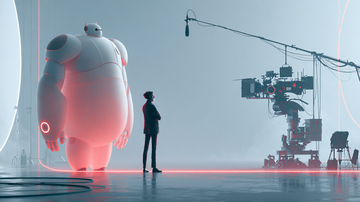
The vast other worlds of science-fiction and fantasy were long created by actors performing before green screens, followed by months of computer compositing.
In recent years, a technology that overturns that convention has become established on set: The Volume, a stage surrounded by giant LED walls.
It displays the background on set and records it with the live action, shifting work once left to post-production into principal photography.
What Is The Volume? Finishing the Background on Set
The Volume is a cylindrical or semicircular stage surrounded by giant high-resolution LED video walls. Its prototype was StageCraft, the virtual-production technology Industrial Light & Magic developed for the Disney+ series “The Mandalorian.”
Traditional green-screen compositing brings green spill, mismatched eye lines, and lengthy post-production. The Volume addresses these through in-camera visual effects, or ICVFX.
A real-time 3D engine such as Epic Games’ Unreal Engine renders photorealistic CG backgrounds on the LEDs, which are photographed with performers and physical sets. Much compositing moves into principal photography, and the viewfinder already shows an image close to the “final pixel.”
An Evolution Descended from Rear Projection
The idea was not sudden. Projected backgrounds date to the Schüfftan process in 1920s “Metropolis” and the rear projection familiar from old westerns and Hitchcock films.
Unlike those flat methods with broken perspective, The Volume changes background perspective in real time with camera movement. Its foundation includes Paul Debevec’s 1998 image-based lighting: wrap a subject in HDR imagery and use the environment itself as a light source. In 2002, 156 LEDs realized the idea as Light Stage 3.
It evolved into the Light Box for “Gravity” in 2011. A direct precursor appeared in “Rogue One: A Star Wars Story” in 2015–16, when cinematographer Greig Fraser displayed space imagery on huge LEDs to create natural reflections on cockpit glass and faces.
That success reached ILM and Epic engineers and combined with Jon Favreau’s VR location-scouting experience on “The Lion King,” culminating in StageCraft for “The Mandalorian” in 2019: a wall about six meters high and 23 meters across, covering 270 degrees with ceiling panels.
Inner and Outer: The Dual-Frustum Mechanism
Sophisticated rendering turns The Volume from a large display into a convincing space. For season two, ILM introduced Helios, its real-time cinematic renderer, moving from first-generation reliance on commercial game engines into film-quality ray tracing.
Its key device is a dual frustum. A frustum is the portion of virtual space within the camera’s view. Rendering the entire wall at maximum resolution is impractical, so the system handles two regions simultaneously.
The inner frustum actually seen by the camera synchronizes perfectly with its position and field of view, rendering perspective-corrected imagery at the highest resolution.
The unseen outer frustum stays fixed at lower resolution and supplies natural ambient light and accurate reflections in eyes and props. This divides the workload while preserving required image quality and 360-degree illumination. Systems such as Mo-Sys StarTracker follow the camera to millimeter precision; LED pixel pitch is typically selected between roughly 1.5 and 2.8 mm.
From “Fix It in Post” to Building It in Advance
The Volume shifts the center of production. Instead of months fixing images after filming, near-final CG must be ready on the LED wall by the first shooting day. Pre-production expands dramatically; a virtual art department may begin five or six months before a production on the scale of “The Mandalorian.”
Major script or art changes during filming become difficult because assets must be rebuilt. When planning holds, however, post-production fixes and reshoots fall sharply. Cinematographers and lighting teams benefit most because the wall itself becomes a vast, organic light source.
On the reflective armor of “The Mandalorian,” desert sunlight and starlight naturally appear in the metal without digital correction. Off-camera panels can become light cards whose shape, color, and direction are moved from an iPad.
Actors also benefit from life-size scenery and creatures in front of them. Zoë Kravitz, who played Catwoman in “The Batman,” said a sunrise she could actually see made performing much easier.
Crews also escape moving sunlight and weather. A “magic hour” that lasts minutes on location can be held for hours, while a button changes morning New York into outer space, reducing travel and weather delays.
Not Universal: Moiré, Color Shift, and Cost
The Volume is no cure-all. Its largest optical problem is moiré, unwanted stripes caused by interference between the regular pixel patterns of the LEDs and camera sensor. A quick response is shallow depth of field that blurs the background. Crews also adjust camera-to-panel distance and angle by centimeters and degrees, add haze, or soften focus. Another challenge is color shift and metameric failure.
Because LED spectra differ from daylight, colors that look correct by eye can shift dramatically on camera. Strict pre-shoot calibration is essential.
Netflix released the open-source OpenVPCal for this problem. A color chart is displayed and filmed by the production camera, then a compensating 3D LUT is applied to the pipeline. At least 10-bit color depth must be retained throughout or banding destroys smooth gradients and realism.
Cost remains a high barrier. Huge LEDs, tracking systems, and high-performance server “brain bars” require enormous initial and operating investment. Cinematographer David Klein called it “a rich person’s process,” and full-scale operation remains concentrated in large-budget work. A shortage of skilled operators also limits adoption.
The Range Demonstrated by Major Productions
The technology’s flexibility appears across productions. “The Mandalorian” filmed more than half its first season without locations and advanced further in season two through Helios and virtual extensions of physical sets.
Favreau extended the approach to the theatrical “The Mandalorian & Grogu,” shot for IMAX and released in May 2026, deepening the physical-digital fusion from streaming to giant screens. It also works for real-world cities.
“The Batman” (2022) built a dark, decaying Gotham and used LED sunsets to cast light directly on Batman and Catwoman, creating noir weight unavailable through external lighting and green screen. Netflix’s “1899” (2022) is renowned for enclosed spaces and ocean scenes.
Shot at the permanent DARK BAY studio in Babelsberg, Germany, it used a rotating stage and rain system. Its “pizza slice” method rotated decks and cabins within the limited 270-degree screen, changing ocean angles and travel direction without rebuilding sets.
Martin Scorsese’s “The Irishman” (2019) combined AI de-aging with three cameras, freeing actors from motion-capture suits. Netflix’s “Red Notice” (2021) used mobile LEDs to safely film difficult action on moving trains and inside helicopters. “The Book of Boba Fett,” “Obi-Wan Kenobi,” “Andor,” and “House of the Dragon” show it becoming a standard option across genres.
GhostFrame Breaks the Multicamera Barrier
A longstanding weakness was difficulty shooting different angles simultaneously. Because the inner frustum follows one primary camera, perspective is distorted from a second position. GhostFrame, patented technology from Megapixel VR, AGS, ROE Visual, and others, overcomes this by synchronizing extremely fast LED refresh with camera shutters to nanosecond precision.
The wall invisibly alternates subframes for cameras A and B, a compositing green screen, or tracking markers. Each camera opens only when its own frame appears, extracting several correct images and compositing elements at once from one screen.
As AGS CEO Peter Angel notes, uses include safe live camera switching and region-specific sponsor logos. It is already used in real-time settings such as Fox Sports programming and Valve esports broadcasts.
Japan’s Leading Studios
As Hollywood’s practice matures, world-class investment is also growing in Japan. Toei created a virtual-production department at its Tokyo studio in October 2022 and announced roughly ¥2 billion of investment through March 2027.
Its converted Stage 11 was among Japan’s largest when announced: AOTO RM1.5 panels at 1.56-mm pitch form a 30-by-5-meter, 270-degree arc with 19K horizontal resolution and 1,500-nit brightness.
The ceiling uses 6,000-nit AOTO M3.7H panels, while the arc is about 12 meters in diameter. A six-meter floor opening accepts a vehicle turntable, supporting driving shoots with scenery accurately reflected in the body.
Mo-Sys StarTracker emits markers only during instants invisible to the camera, preventing reflections. Former ILM staff support an internal CG-asset pipeline. Sony PCL opened Kiyosumi Shirakawa BASE in February 2022 with its high-resolution Crystal LED B-series.
Its low-reflection curved screen measures 15.2 by 5.4 meters at 1.58-mm pitch. Vertical integration from LED to Sony VENICE cinema cameras is its strength; Camera Sync coordinates shutters and displays to reduce characteristic line noise. Development also extends beyond greater Tokyo.
HCA factory. in Yachimata, Chiba converted a former equestrian arena into a flexible experimental studio with 600 tsubo of usable space, among Japan’s largest. Audio-visual specialist Hibino operates Hibino VFX Studio and rents systems such as the large Ruby2.6F for agile film, commercial, and music-video shoots.
Beyond Democratization
The Volume is more than a green-screen replacement. It reorganizes the production timeline and returns control of image quality and creativity to directors and cinematographers on set. Optical and physical issues such as moiré and color shift remain, alongside expanded preparation and huge capital costs.
Multicamera systems such as GhostFrame and open-source color management such as OpenVPCal are rapidly lowering those barriers. Preconfigured turnkey systems such as Vu One and affordable tracking such as VIVE Mars CamTrack are opening access for independent and mid-budget productions.
Toei, Sony, HCA, and others are developing world-class infrastructure and experiments in Japan. The border between real locations and virtual sets will continue to blur, with hybrid choices based on budget and purpose becoming normal. The Volume is becoming the most powerful canvas for depicting the nonexistent as though it were truly photographed there.