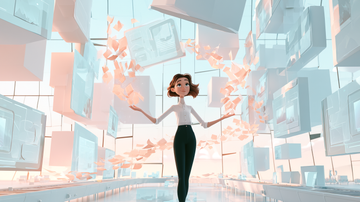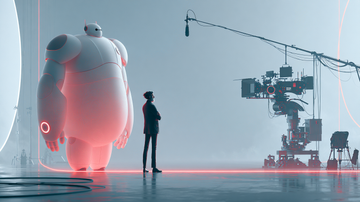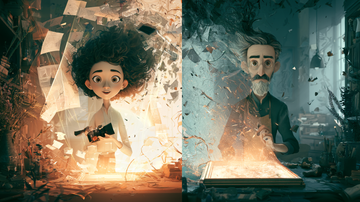

The 12 principles of animation summarize fundamental techniques and approaches to animation production. Walt Disney animators Ollie Johnston and Frank Thomas presented them in their book The Illusion of Life: Disney Animation. They are important elements in making animation look realistic and appealing. The 12 principles are explained below.
1. Squash and Stretch
This expresses changes in an object’s shape as it moves or responds to force. Emphasizing elasticity and a sense of mass gives movement life.
2. Timing and Spacing
Controlling the speed and spacing of movement adjusts how an action is expressed. Fast movement communicates tension and energy, while slow movement suggests weight or grace.
3. Anticipation
A preparatory movement before the main action visually signals what comes next, helping viewers anticipate what will happen.
4. Straight Ahead and Pose to Pose
Straight ahead means drawing animation sequentially, frame by frame, producing naturally flowing movement. Pose to pose means establishing key poses first and filling the intervals between them, creating planned, clearly defined movement.
5. Follow Through and Overlapping Action
After the main movement ends, affected parts continue moving with a delay, giving the motion a natural continuation and aftereffect.
6. Slow In and Slow Out
Changing speed at the beginning and end of a movement makes the action feel smooth. This adds emphasis and increases naturalness.
7. Arcs
Natural movement usually follows an arc rather than a straight line. Incorporating arcs makes motion feel realistic.
8. Secondary Action
Movements accompanying the main action add complexity and depth to a character’s motion. Examples include swinging the arms while walking or changing facial expressions.
9. Timing
Appropriate timing expresses a character’s or object’s weight, personality, and emotions. Adjusting timing greatly influences a character’s performance.
10. Exaggeration
While based on realistic movement, animation can use exaggeration to make characters and actions more dramatic and appealing.
11. Continuous Depiction (Solid Drawing)
Drawing with awareness of a character’s or object’s three-dimensional form and balance gives the movement greater credibility.
12. Appeal
Characters and actions need to be appealing and engaging to viewers. Character designs, movements, and expressions should be created so that people find them attractive.
Understanding and appropriately applying these principles makes animation more lively and visually appealing.
Related Articles to Read Next
The following articles and categories also explore related topics. Start with the areas you need to make it easier to connect your understanding of planning, shooting, editing, and AI use.
- Video Production
- Creating Movement in Animation: Applying Motion Tweening to Video Production
- An Introduction to Particles in After Effects: Basics for Adding Movement to Video Production
- An Introduction to After Effects Expressions: Basics for More Efficient Video Production
Need Help with Video Production?
Lead readers toward consultations on motion graphics and educational video production. For specific advice on planning, shooting, editing, or using AI, please feel free to reach out through our contact page.
Get Information on Video Production and AI
Introduce information on animation, motion graphics, and video editing. We also share the latest video production know-how and AI video tips through our newsletter.