
Holographic Technology's Future Impact on Video Production
Holographic technology has the potential to transform video production's future. It will allow viewers to experience images in three-dimensional space beyond physical screens. Its influence will extend beyond film and television into live performances, education, and medicine. This article explains how holographic technology can innovate production and expand the possibilities of future experiential video.
Holographic Technology Basics and Its Evolution
Holographic technology uses light to reproduce three-dimensional objects realistically. Unlike conventional two-dimensional images, it provides visual depth and dimension, making objects or people appear to exist directly before us. Earlier holograms mainly projected static objects, but recent advances are beginning to make moving three-dimensional images generated in real time possible.
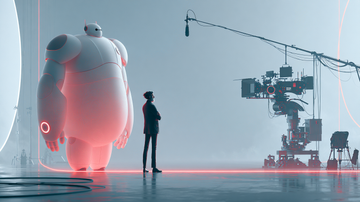
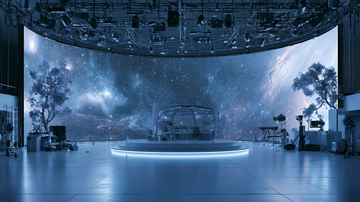
As holographic technology evolves, physical sets and green screens will be used less in production, with holograms creating virtual spaces instead. Projecting CG characters or complex scenes holographically, for example, can make actors and virtual characters appear to occupy the same space in real time. This should allow freer depiction of scenes and stories impossible with conventional methods.
Applications in Entertainment
Holographic technology could also substantially transform entertainment. Using holograms in concerts and live performances can give distant audiences the feeling that artists are right before them. Performances that recreate deceased artists holographically have already attracted attention, and further advances should offer new forms of entertainment.
Using holograms in cinema could also let audiences enter the images within the theater. They might experience the story's world from a 360-degree perspective and feel as though they were speaking directly with its characters. Film would thus evolve into experiential entertainment involving sight, sound, and spatial perception together.
Combining Holograms with Education
Holographic technology is expected to play a major role in education. History classes, for example, could recreate ancient buildings or battlefields holographically so students learn as though present. In science and technology, holograms could display the body's internal structure in three dimensions for more intuitive anatomy learning. Holograms can therefore greatly enhance visual learning and bring new possibilities to traditional teaching.
Recreating distant students or teachers as holograms would also enable real-time remote classes across physical distances. This could establish access to high-quality education anywhere in the world and substantially change how education works.
Applications in Medicine
Holographic technology also holds great medical potential. Before surgery, holograms can display a patient's internal structures in three dimensions and allow doctors to simulate the procedure. This is expected to improve surgical success rates and reduce the burden on patients. Remote doctors assisting through holograms could also help equalize care quality across geographical barriers.
Hologram-based rehabilitation and counseling are also attracting attention. Patients could perform rehabilitation at home using holograms, progressing with treatment while receiving real-time feedback. This should make high-quality medical services accessible even to patients in remote locations.
Challenges and Prospects
Despite its potential, holographic technology faces challenges to widespread adoption. Real-time hologram generation requires substantial processing power and extensive infrastructure. Technology for creating visually realistic holograms is also still developing. Devices and environments for displaying them remain expensive for ordinary homes and public facilities, so adoption is expected to take time.
As technology improves and costs fall, however, holograms should become more widely used. A future in which they operate across entertainment, education, medicine, business, tourism, and other fields is coming into view. How holograms will be used in production and transform daily life is an exciting prospect.
Conclusion
Holographic technology is an innovative tool that brings fresh perspectives to production and strengthens interaction with viewers and a sense of presence. A future awaits in which holograms change visual experiences across entertainment, medicine, education, and other fields. Challenges remain, but their evolution will take production and expression into a new dimension. Expectations are growing for further developments and applications.
Related Articles
The following articles and categories also cover related topics. Start with the areas you need, and it will be easier to connect your understanding of planning, shooting, editing, and using AI.
- Video Production Category
- The Evolution of Immersive Video: Applying VR and AR to Corporate Videos and Content Production
- Using 360-Degree Video: Production Basics for Immersive Corporate and Facility Introduction Videos
- An Era of Controlling Video with Brainwaves: Perspectives on UX and Interactive Video Production
Need Help with Video Production?
Connect readers to consultations on exhibition content and experiential video production. For specific advice on planning, shooting, editing, and using AI, visit our contact page and feel free to get in touch.
Receive Information on Video Production and AI
Provide information on holograms, AR and VR, exhibition videos, and video production. We also share the latest video production know-how and AI video production tips in our newsletter.