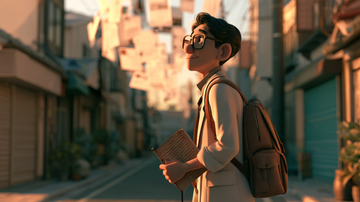

A Childhood at a Cultural Crossroads

Kazuhiko Hasegawa was born in Tokyo in 1946, just after the war. His childhood unfolded in a distinctive environment where an influx of American culture collided intensely with Japanese traditions. Influenced by his father, he became familiar with motion pictures from an early age, and cinemas became his second school. His encounter with Akira Kurosawa's films in particular decisively influenced his later visual expression. As a boy amid postwar social change, Hasegawa keenly sensed Japan wavering between old values and new ideas. The sensitivity cultivated then would become the origin of the sharp social criticism found in his later work.
The Awakening of Rebellion and Creativity

As he entered adolescence, Hasegawa developed a strong rebelliousness toward the existing education system and authority. Unable to fit into school's restrictive discipline, he sought a place to express his creativity. Acquiring an 8 mm camera in high school became a turning point, and he began making improvised films with friends. Those works already offered glimpses of the experimental visual expression and questioning of society that would characterize his later films. While influenced by the French New Wave and American underground cinema popular at the time, he valued his perspective as a Japanese filmmaker and continued searching for his own visual language.
The Formation of His Ideas at Nihon University

His passion for film took him to the Department of Cinema at Nihon University's College of Art. There, he began to think deeply about cinema's ideological dimensions and social significance as well as its techniques. As student activism grew in the late 1960s, his political awareness increased and he strengthened his commitment to questioning society through film. His university practice films already displayed the vivid visual sensibility and socially critical messages that would characterize his later work. During this period, his exchanges with avant-garde artists such as Shuji Terayama and Juro Kara also led him to explore expressive possibilities beyond conventional ideas of cinema.
Challenging Society Through Images

After graduating, Hasegawa continued pursuing his own visual expression rather than fitting into the established film industry. His work, exemplified by The Man Who Stole the Sun, posed fundamental questions to existing social systems and authority while also innovating cinematic expression. His keen observation cultivated since childhood, adolescent rebelliousness, and political perspective developed at university came together to form his distinctive film world. The visual language Kazuhiko Hasegawa created went beyond entertainment and had the power to encourage audiences to question society and themselves. The rebellious spirit running consistently through his work expressed an unwavering film philosophy nurtured by his formative experiences.