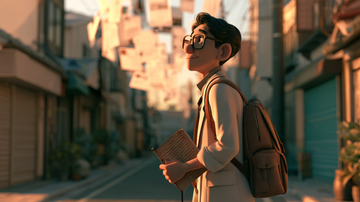

A Story Begins with the Original Subject of Dictionary Compilation

Released in 2013, The Great Passage is Yuya Ishii's carefully crafted adaptation of Shion Miura's novel of the same name. Choosing the seemingly unassuming subject of dictionary compilation, he successfully wove it into a universally resonant human drama. Ryuhei Matsuda's subtle performance as protagonist Mitsuya Majime, together with the relationships among the distinctive characters working in the unusual setting of a dictionary editorial department, deeply moves viewers.
Human Growth Portrayed Through Love of and Devotion to Words

A notable feature of the film is its portrayal of the passion and struggles of the editors devoted to creating a new dictionary, Daitokai. Ishii's meticulous direction convincingly depicts how Majime, who struggles with communication, gradually grows through dictionary-making. The earnest debates over word definitions and the sometimes philosophical conversations are particularly effective in prompting us to reconsider the power and appeal of words themselves.
The Tension Between Changing Times and Tradition

Ishii also incorporates a larger theme: the significance of printed dictionaries in an increasingly digital society. The differences in generation and values between veteran editor Matsumoto, played by Masato Sakai, and the younger Majime are portrayed not as a simple conflict but as a process of mutual understanding and growth. The romance with Komako, played by Aoi Miyazaki, also serves as an important subplot suggesting how words can help people understand one another.
The Essence of Direction That Creates Universal Emotion

In The Great Passage, Ishii tells the story with direction attentive to every detail. His skill in transforming the specialized work of dictionary compilation into a human drama anyone can relate to deserves particular recognition. The camerawork is equally accomplished, carefully capturing both the quiet atmosphere of the dictionary editorial office and the smallest nuances of the characters' feelings. The Daitokai completed at the film's end is presented not simply as a dictionary but as an embodiment of the souls and aspirations of everyone involved, deeply moving viewers. The film can be said to have secured a firm place in Japanese film history as one of Ishii's signature works.