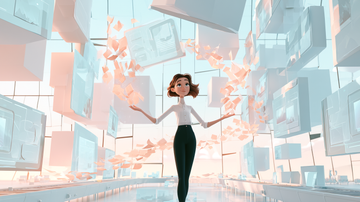
Animation has broadened the range of visual expression as it has evolved from hand-drawn lines to cel animation, CG, and digital production. As production technology has changed, approaches to character movement, background expression, photography processes, and editing have also changed significantly.
This article organizes the evolution of animation technology through the progression of “hand-drawn animation,” “cel animation,” “CG,” and “digital production,” and explains how visual technology has affected expression. It is an introductory guide for people who want to learn the history of animation production and understand the foundations that connect to contemporary video production and expression in the AI era.
Three Perspectives for Understanding the Evolution of Animation Technology
When examining the evolution of animation technology, it is easier to understand when organized from three perspectives: the production process, methods of expression, and the viewing experience. With hand-drawn and cel animation, processes such as key animation, in-betweening, coloring, and photography centered on physical materials. In digital production, however, drawing, coloring, photography, compositing, and editing can be handled as data, increasing the freedom to make revisions and create new forms of expression.
CG and digital compositing have also expanded the possibilities for camera work, light, texture, and spatial expression. Higher resolutions, streaming environments, smartphone viewing, and AI-assisted production have further transformed animation into a form of visual expression viewed on many kinds of screens and in many contexts.
The Birth and Evolution of Animation
Animation is a genre that has undergone an especially distinctive evolution within moving images. From its birth to the present day, it has evolved alongside technological innovation and become a central form of entertainment.
The Beginnings of Animation
The origins of animation date back to the 19th century. At the time, optical toys such as the zoetrope and phenakistiscope appeared as technologies that used sequences of still images to create the illusion of movement. They established concepts that form the foundation of animation today. Later, *Fantasmagorie*, created by French artist Émile Cohl in 1908, became known as the world’s first animated film.
The Basics of Hand-Drawn Animation and Cels
Hand-drawn animation creates movement by showing individually drawn pictures in succession. Cel animation is a production method in which characters are drawn on transparent sheets, layered over backgrounds, and photographed. It remained at the center of commercial animation for many years.
The strength of cel animation is that the lines, colors, and textures unique to hand drawing remain visible in the finished work. On the other hand, production requires a great deal of labor and time, and revisions and complex compositing face constraints. The introduction of digital drawing and digital photography compensated for those constraints while broadening the range of expression.
The Golden Age and Feature-Length Animation
From the 1930s through the 1950s, the United States entered a period known as the “Golden Age of Animation.” During this period, Disney produced one feature-length animated film after another, including *Snow White*, *Pinocchio*, and *Fantasia*, demonstrating that animation was entertainment that adults as well as children could enjoy.
Technological Evolution in Japanese Animation Production
Animation also followed its own distinctive course of development in Japan. After the war, Osamu Tezuka’s *Astro Boy* was broadcast as a television anime and laid the foundations of animation culture in Japan. Innovations in limited animation developed ways to convey striking movement and expressions even within constrained production environments.
How CG and Digital Production Changed Methods of Expression
The spread of CG and digital production made it easier for animation to handle camera movement, backgrounds with depth, lighting treatments, and complex effects. Digital technology has greatly expanded production options, especially for action scenes, mechanical subjects, crowds, and urban environments.
Digital technology does not, however, replace hand-drawn expression. In contemporary animation production, it has become important to combine the emotional expression of hand drawing with the efficiency and extensibility of digital techniques.
Where Is Animation Production Heading in the AI Era?
In recent years, a growing number of technologies have supported production processes, including AI-assisted drawing, background generation, interpolation, and editing support. AI is beginning to be used not only to automate production, but also as a tool for accelerating planning, prototyping, review, and revision.
Related Articles on Animation Technology
- From Cels to Digital: The Evolution of Japanese Animation Production Technology and Visual Expression
- Hand-Drawn and Digital Techniques in Studio Ghibli Films
- 12 principles of movement
- Dissecting Movement in Animation
Related Articles to Read Next
Related themes are also organized in the following articles and categories. Starting with the areas you need makes it easier to connect your understanding across planning, filming, editing, and the use of AI.
- AI Technology Category
- How Will AI Change Video Editing? Practical Points for Automated Editing, Subtitles, and Quality Control
- The Evolution of Video Technology: Fundamentals for Applying Filming, Sound, and AI to Video Production
- Project Odyssey AI Filmmaking Competition: Possibilities and Lessons in Generative-AI Video Production
- The Evolution of Japanese Animation Production Technology: Perspectives for Video Production in the AI Era
- The 12 Principles of Animation: Applying the Fundamentals of Movement to Video Production
Need Help with Video Production?
Provide a route to consultations on corporate video production using animation and motion graphics. For specific advice on planning, filming, editing, or using AI, please feel free to contact us through the contact page.
Receive Information on Video Production and AI Use
Provide a path for receiving information on animation, AI video production, and editing expression. We also share the latest video-production know-how and tips for AI video production through our newsletter.